Retro European Fashion Illustration
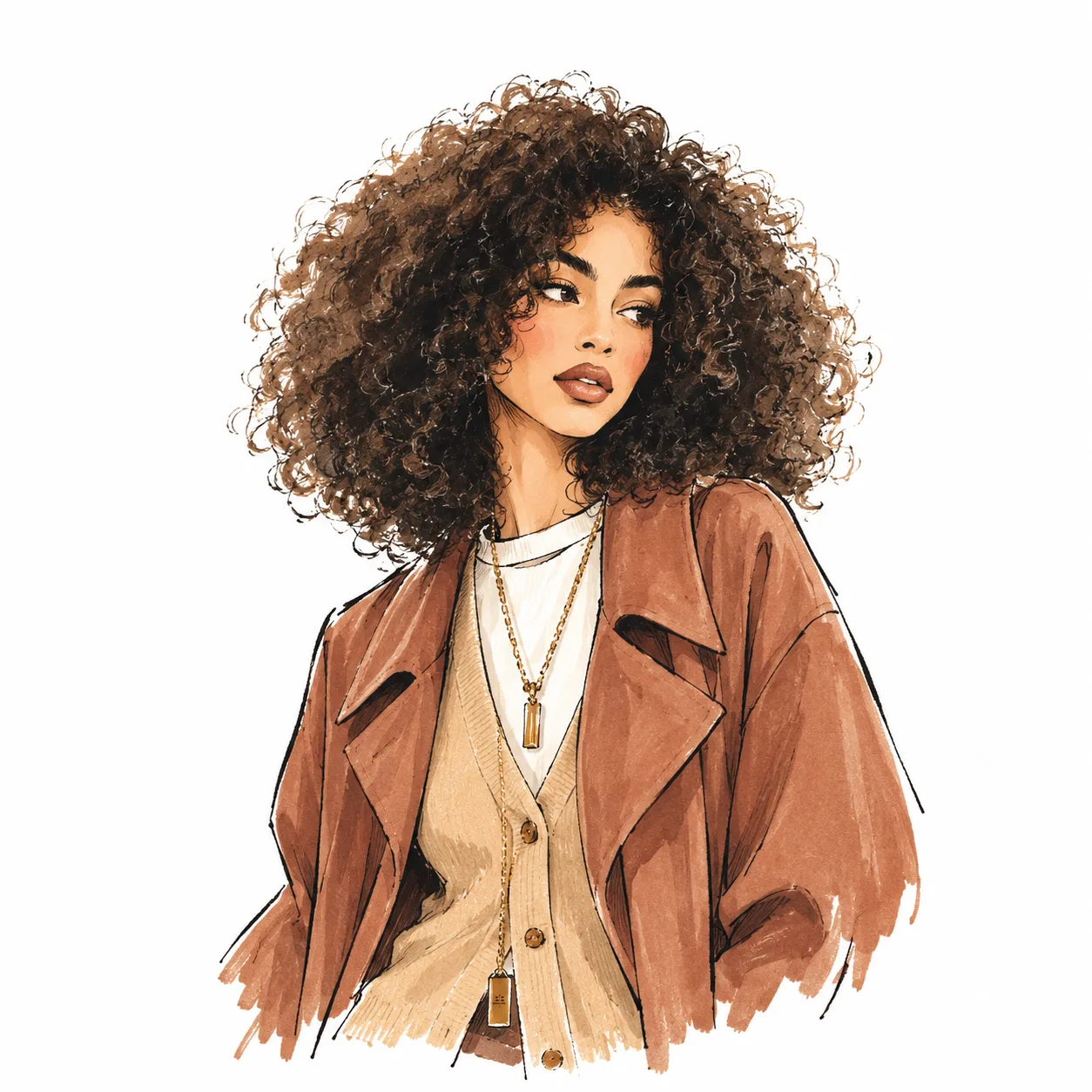
Model: GPT Image · Category: Anime / Illustration
# Retro European Fashion Illustration — Image Generation Prompt

A light, charming, hand-drawn illustration reminiscent of vintage European fashion illustrations.

**Format:** 1:1 square canvas, plain white background, designed for a social media profile icon.

Illustrate one stylish adult woman, shown only from the upper body. Keep the woman and the theme relatively small and centered, occupying approximately 45–55% of the overall canvas. Leave generous white space on all four sides.

Frame the woman from the chest to around the waist. Do not include the full body or legs.

## [MOST IMPORTANT: Body, Face, and Gaze]

The body must always face diagonally forward. Avoid a straight-on frontal pose. Use a natural three-quarter angle, with either the left or right shoulder slightly closer to the viewer.

The shoulder line should appear diagonal, and the body should have a subtle twist.

Do not point the face in exactly the same direction as the body. Introduce a slight difference between their orientations.

The face must not always look directly at the camera. Depending on the theme and gesture, vary the head position and gaze naturally. For example:

- Turn the face sideways.
- Look diagonally to one side.
- Glance sideways as if looking back over the shoulder.
- Tilt the face toward the theme.
- Lower the chin slightly and look down.
- Turn the face sideways while lowering the eyes.
- Shift only the gaze to the side.
- Look down at the hands.
- Gently gaze at the theme.
- Look away as if gazing into the distance.
- Close the eyes with a soft smile.
- Look sideways while directing the eyes downward.

Avoid direct eye contact with the camera as a general rule.

Do not create a stiff pose in which the face, body, and gaze all point in the same direction.

Introduce subtle differences, such as the body facing diagonally forward, the face turned sideways, and the eyes looking in yet another direction. This creates the natural movement and elegance characteristic of fashion illustrations.

Slightly tilt the neck, raise one shoulder, or gently twist the torso. Avoid compositions that resemble a static passport photograph.

## [Character]

A slender, delicate adult woman with a long, elegant neck.

Her shoulders and arms should be slim, with light, graceful proportions typical of fashion illustrations.

Avoid the body proportions of a young girl or a childish facial appearance.

Give her a small face with clean, refined contours, a slender nose bridge, small eyes, and small lips. Keep the facial features simple.

The overall impression should be sophisticated, fashionable, feminine, and mature.

Keep the expression understated rather than overly elaborate. Examples include a subtle smile, quietly observing something, or looking down thoughtfully.

## [Hairstyle and Hair Color]

Vary the hairstyle each time to complement the theme and outfit, drawing inspiration from retro European fashion.

Use bob hairstyles as a primary option, but naturally select from a variety of styles, including:

- Straight chin-length bob.
- Bob with inward-curled ends.
- Bob with outward-flipped ends.
- Softly wavy bob.
- Rounded, voluminous bob.
- Classic bob with bangs.
- Side-parted bob without bangs.
- Short bob tucked behind the ears.
- Short French bob.
- Wavy short hair.
- Medium-length hair with soft curls.
- Shoulder-length hair with outward curls.
- Low ponytail.
- High ponytail.
- Ponytail with curled ends.
- Low chignon.
- Compact bun.
- Half-up hairstyle.
- Updo with a wrapped scarf.
- Hairstyle paired with a slim headband.

Do not fix the hair color. Choose naturally from black, dark brown, chocolate brown, reddish brown, chestnut, light brown, honey brown, dark blonde, golden blonde, ash blonde, red, auburn, and other suitable shades.

Vary the combinations of hairstyle, hair color, and clothing each time so that the illustrations do not look too much like the same woman.

## [Fashion and Clothing]

Base the fashion on classic, feminine, retro European styles.

Since the illustration focuses on the upper body, vary the collars, sleeves, neckline, and shoulder details to make the outfit visually appealing.

Possible clothing options include:

- White blouse.
- Peter Pan collar blouse.
- Bow-tie blouse.
- Puff-sleeve blouse.
- Shirt with rolled-up sleeves.
- Short-sleeve knit top.
- Ribbed knit top.
- Turtleneck.
- Knit cardigan.
- Cropped cardigan.
- Sleeveless top.
- Collared dress.
- Shirt dress.
- Sleeveless dress.
- Fine polka-dot patterns.
- Gingham checks.
- Small floral prints.
- Fitted jacket.
- Collarless jacket.
- Tweed-style jacket.
- Trench coat.
- Slim-fitting coat.

Choose the clothing freely according to the theme.

Adjust the sleeve length naturally according to the season, using short sleeves, three-quarter sleeves, long sleeves, or sleeveless designs as appropriate.

## [Accessories]

When appropriate, incorporate just one or two accessories, such as:

- Scarf.
- Small neckerchief.
- Slim headband.
- Ribbon.
- Gloves.
- Beret.
- Small hat.
- Sunglasses.
- Small earrings.
- Simple necklace.

Do not overload the illustration with accessories. Prioritize simplicity, elegance, and generous white space.

## [Interaction with the Theme or Subject]

Think carefully about how the woman interacts with the theme so that the relationship is clearly communicated even within an upper-body composition.

Consider the theme's defining characteristics, size, shape, purpose, and overall mood when designing the gesture.

Do not always depict her simply holding the subject while facing forward.

Instead, choose gestures that feel natural and specific to the subject, such as:

- Cradling it with both hands.
- Holding it close to her chest.
- Balancing it on one hand.
- Gently cupping it with both hands.
- Holding it beside her face.
- Lifting it slightly.
- Leaning forward to look at it.
- Bringing her cheek close to it.
- Taking it out from near her chest.
- Holding it under one arm while looking in the opposite direction.
- Bringing her face closer to the subject.

Do not always make her look directly at the subject. Introduce stylish fashion poses in which she holds the subject while looking away, shifts her gaze sideways, or lowers her eyes thoughtfully.

Maintain the subject's natural proportions and scale. Do not make it unnaturally large or place it on top of her head.

## [Color Palette]

Do not use the same color combinations every time.

Choose approximately two to four main colors from a palette that may include:

- Ivory.
- Cream.
- Beige.
- Camel.
- Brown.
- Black.
- Navy.
- Gray.
- Muted blue.
- Pale blue.
- Mint green.
- Olive.
- Mustard.
- Lemon yellow.
- Coral.
- Salmon pink.
- Dusty pink.
- Red.
- Burgundy.

Keep the white background and white negative space prominent. Avoid using too many colors.

## [Illustration Style and Technique]

Use fine, sharp, hand-drawn ink lines in black or dark brown.

Keep the outlines clean and refined, without excessive detail.

Allow slight irregularities, subtle waviness, and occasional texture in the lines to preserve the charm of hand drawing.

Leave a large amount of the paper surface white. Apply simple, selective colors only to essential areas such as the clothing, hair, accessories, cheeks, and theme-related subject.

Do not use a softly blurred watercolor treatment. Instead, make the ink lines the main visual feature, with clear, slightly flat coloring.

Retain subtle variations in color that resemble quick, effortless brushwork.

Keep shading, gradients, and realistic three-dimensional rendering to a minimum.

Use a limited color palette and generous areas of white to create a bright, airy, elegant result.

The overall mood should be retro, sophisticated, stylish, feminine, light, charming, and slightly playful.

## [Variation Across Generations]

Vary the following elements every time:

- Hairstyle.
- Hair color.
- Clothing.
- Accessories.
- Direction of the body's tilt.
- Direction of the face.
- Neck angle.
- Gaze.
- Arm and hand positions.
- Interaction with the theme.
- Color palette.

Do not repeatedly use the same composition of a diagonally turned body with the woman looking at the subject.

Keep the body generally facing diagonally forward, but vary the face and gaze more boldly so that each illustration features a distinct fashion pose.

## [Restrictions]

- No background scenery.
- No buildings.
- No furniture.
- No text.
- No logos.
- No signatures.
- No full-body compositions.
- No legs.
- No straight-on frontal body pose.
- No straight-on frontal face.
- No stiff, passport-photo-like compositions.
- No poses that always look directly at the camera.
- No photorealism.
- No anime style.
- No childish or young-girl appearance.
- No 3D rendering.
- No contemporary digital-painting style.

Create an original illustration inspired by the characteristics of retro European fashion illustration without copying the work of any specific artist.